Who was Mahavir?
The prince who became the twenty-fourth Tirthankara, told through the traditional accounts.
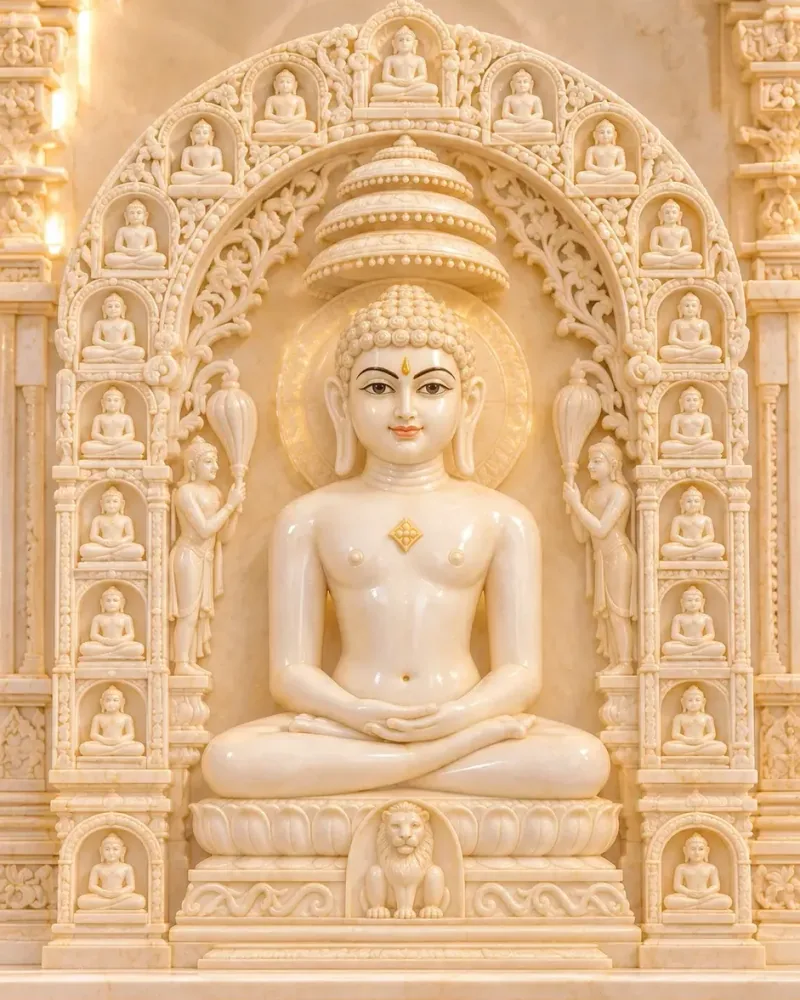
Vardhamana, later called Mahavira, “the great hero”, is revered in Jainism as the twenty-fourth and last Tirthankara of our age: a ford-maker who crossed the river of birth and death and showed others the way across. His heroism was not won on a battlefield. It was the slow, uncompromising conquest of anger, pride, deceit and greed within himself.
Jains do not see him as the founder of their faith but as the latest teacher in a long line. His predecessor, Parshvanatha, is widely accepted by historians as a figure who lived roughly two and a half centuries earlier.
Birth
Born to King Siddhartha and Queen Trishala in Kundagrama, near Vaishali in present-day Bihar. Tradition tells that Trishala saw auspicious dreams before his birth, and that the kingdom prospered, so he was named Vardhamana, “ever-increasing”.
Early life
Raised a Kshatriya prince of the Jnatri clan, he was known for fearlessness and a reflective temperament. Svetambara tradition records his marriage to Yashoda and a daughter, Priyadarshana; Digambara tradition holds that he never married.
Renunciation
At thirty, after his parents’ passing, he gave away his wealth, left the palace and took up the life of a wandering ascetic.
The long practice
For about twelve and a half years he fasted, kept long silences and meditated through heat, cold and hostility, choosing not to harm any being in return.
Kevala Jnana
At around forty-two, meditating beneath a sal tree by the Rijupalika river, he attained kevala jnana, complete and unobstructed knowledge.
Teaching
For some thirty years he taught in the everyday Ardhamagadhi language so that anyone could understand, gathering a fourfold community of monks, nuns, laymen and laywomen.
Nirvana
At seventy-two he attained nirvana at Pavapuri. Jains remember that night each year on Diwali with lamps of knowledge.
Ages and durations follow the traditional Jain accounts; Svetambara and Digambara sources differ on some details.
Common questions
Who was Bhagwan Mahavir?
Bhagwan Mahavir, born Vardhamana, is revered in Jainism as the 24th and last Tirthankara of the present cosmic age. He renounced royal life at thirty, attained Kevala Jnana (omniscience) after more than twelve years of meditation and austerity, and taught non-violence, truth and non-possessiveness for about thirty years.
Did Mahavir found Jainism?
No. Jain tradition regards the dharma as eternal and Mahavir as the 24th Tirthankara in a long succession. His predecessor, Parshvanatha, is generally accepted by historians as a historical teacher who lived around 250 years earlier.
When was Mahavir born?
The traditional Jain chronology gives 599 BCE for his birth and 527 BCE for his nirvana. Many historians place his life somewhat later, in the 6th or 5th century BCE, so exact dates remain debated.
Why are idols of Mahavir shown with open eyes?
Many Svetambara Jain temples adorn their idols with open eyes, often of inlaid crystal or silver, as part of the worship tradition. Digambara idols are typically shown with downcast, meditative eyes. Both express the same ideal: a fully awakened, perfectly peaceful being.
What is Anekantavada?
Often translated as “many-sidedness” or “non-absolutism”, it is the teaching that reality is complex and can be known from many standpoints, so no single view captures the whole truth.
When is Mahavir Jayanti celebrated?
On the thirteenth day of the bright half of the lunar month of Chaitra, usually in March or April. Check a Jain calendar (panchang) for the exact date each year.
The journey to peace begins within.
Mahavir did not ask anyone to follow him blindly. He asked them to look inward, as he had. Take one quiet minute now: breathe slowly, and let one thought from this page settle.